

A refundable challenge fee can make a prop trading evaluation more attractive, but the word “refundable” needs careful interpretation. Some firms return the original fee with the first eligible payout, others wait until a later reward milestone, and some refund only part of the payment or exclude certain programs entirely.
For traders comparing proprietary trading firms, this difference can affect the real cost of participating. A challenge advertised as refundable is not necessarily free, and passing the evaluation does not always trigger the refund. In many cases, traders must first qualify for a funded account, follow its trading rules, generate eligible performance rewards, and submit a payout request.
This guide compares seven prop firms with different fee policies. It explains when refunds may become available, what conditions to check, and why a later refund should never be treated as guaranteed income. Leofins ranks fourth in this comparison because its refund policy is relatively straightforward, although the timing depends on the evaluation program selected.
What Does a Refundable Prop Firm Challenge Fee Actually Mean?
A challenge fee is the amount a trader pays to enter an evaluation program. The firm uses the evaluation to assess whether the trader can meet its profit objectives without violating its risk limits.
A refundable fee usually means the firm may return an amount equal to the eligible purchase fee after the trader reaches a specified stage. This is different from a standard consumer refund, where a customer might receive their money back after cancelling a purchase.
Most importantly, three separate events should not be confused:
- Passing the evaluation: The trader completes the required assessment phases.
- Qualifying for a reward: The trader meets the funded account’s payout conditions.
- Receiving the fee refund: The firm returns the eligible fee according to its policy, often alongside a reward withdrawal.
These milestones may happen at different times. A firm might advertise a full refund but require the trader to reach the first, second, third, or even fourth eligible payout. Another may return the fee in stages or exclude particular products.
Before paying, identify the exact program name, the refund milestone, and the conditions that could prevent payment. The policy for one account type should never be assumed to apply to every product offered by the same firm.
Prop Firms Compared: Refund Timing and Conditions
The following comparison focuses on published fee policies rather than advertised account sizes or profit splits. A refund is considered available only where the relevant program terms describe one; it should not be interpreted as a guarantee that a trader will qualify.
| Rank | Prop Firm | Why Traders Consider It | When the Fee Is Returned | Important Condition |
|---|---|---|---|---|
| 1 | FTMO | Established two-step evaluation structure | With the first eligible Reward withdrawal on the 2-Step Challenge | The 1-Step Challenge and Instant Account are not refundable under the published policy |
| 2 | The5ers | Fee credit is distributed across progression milestones on High Stakes | 10% after Phase 1, 20% after Phase 2, and the remaining 70% at the third payout milestone | Refund is delivered as HUB credits, subject to program conditions |
| 3 | FundedNext | Refund policy varies across its Stellar evaluation options | First Performance Reward on Stellar 2-Step; third reward on newer Stellar 1-Step and Stellar Lite accounts | Eligibility depends on model and purchase or reset date |
| 4 | Leofins | Three CFD evaluation formats with a published fee-refund schedule | First reward payout on Core and Starter; second on Edge | The trader must qualify for the relevant payout |
| 5 | FundingPips | A refund is available on a specific evaluation model | Fourth reward on the 2 Step Standard Master Account | Other named models are excluded |
| 6 | FXIFY | Several evaluation structures with fee reimbursement | First eligible payout request on qualifying one-, two-, and three-phase programs | Lightning, Instant Funding, and certain other program variants have different terms |
| 7 | Topstep | Futures-focused Trading Combine with defined pathways | No routine post-funding challenge-fee refund | A limited 14-day satisfaction guarantee applies to eligible new customers who have not passed |
Refund rules can change, and optional platform charges or add-ons may have separate terms. Always confirm the exact product and current policy before checkout.
1. FTMO: A Refund Linked to the First Reward Withdrawal
FTMO offers a clear example of a fee refund tied to a specific evaluation product. Under its published policy, the initial purchase fee for the 2-Step FTMO Challenge is refunded when the trader requests their first Reward withdrawal. The refund is processed using the original payment method.
However, the same policy does not extend to every FTMO product. The 1-Step Challenge and FTMO Instant Account have non-refundable entry fees under the current published terms.
This distinction matters because a trader may see the word “refundable” on a firm’s website and assume it applies to all available account types. That assumption can lead to an incorrect calculation of the challenge’s effective cost.
The two-step structure also means the trader must complete both evaluation phases before becoming eligible for the relevant funded account and later requesting a reward. A successful evaluation alone should not be confused with a completed refund.
Before joining, check the precise challenge name, the refund method, and the conditions for requesting a reward. Also budget for the possibility that the evaluation is unsuccessful and the initial fee is never returned.
Best for: Traders who prefer a structured two-phase evaluation and want a refund policy tied to their first eligible reward withdrawal.
2. The5ers: A Refund Distributed Across Milestones
The5ers uses a different approach in its High Stakes program. Instead of returning the entire fee in one payment at the first payout, its published policy describes a staged refund credited through HUB credits.
According to the policy updated in October 2026, the distribution is:
- 10% of the evaluation fee after completing Phase 1.
- Another 20% after completing Phase 2 and reaching funded status.
- The remaining 70% at the third payout milestone.
This structure means the fee is returned progressively rather than entirely at the beginning of the funded stage. It also means the trader should understand what HUB credits are and how they can be used before treating them as equivalent to cash returned to a bank account.
The firm’s broader payout policy and the conditions for receiving a reward remain important. Reaching a phase milestone does not eliminate the need to comply with the program rules, and the final portion is linked to later progression.
A trader comparing The5ers with a firm that refunds the fee in cash alongside the first payout should account for both the timing and the form of the refund. Two policies may advertise fee reimbursement but offer different practical value.
Best for: Traders comfortable with a staged progression system who understand the distinction between account credits and cash withdrawals.
3. FundedNext: Check the Exact Stellar Model
FundedNext offers different refund schedules across its CFD evaluation programs. The distinction between Stellar 2-Step and Stellar 1-Step is especially important for new purchases under the current policy.
For Stellar 2-Step, the registration fee can be requested with the first Performance Reward withdrawal from the FundedNext Account. The trader must qualify for the reward and select the relevant refund option when submitting the request.
For newer Stellar 1-Step accounts purchased or reset on or after January 12, 2026, the refund is tied to the third Performance Reward withdrawal. Stellar Lite also has a third-reward refund milestone under its published terms. Earlier purchases may remain subject to previous rules, so the date of purchase or reset can matter.
There may also be separate fees that are not refundable. For example, FundedNext’s published help information identifies an additional platform fee for cTrader or Match-Trader that is generally non-refundable, with a stated exception for U.S. clients.
These details make it essential to calculate the total amount paid rather than looking only at the challenge registration fee. If you purchase add-ons, reset an account, or choose a different platform, verify how those costs affect the amount that may be returned.
Best for: Traders comparing several CFD challenge structures who are willing to check product-specific payout and refund terms carefully.
4. Leofins: Three Evaluation Routes and a Defined Refund Milestone
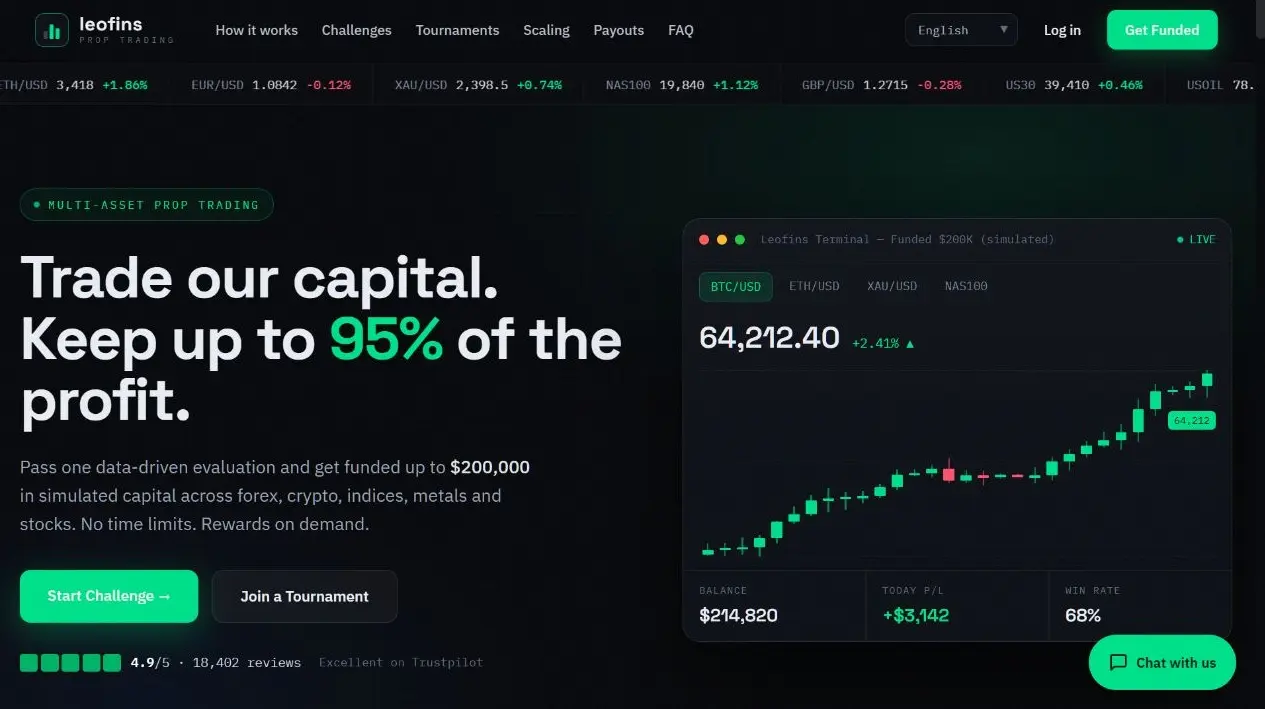 Leofins offers three CFD evaluation programs: Core 2-Step, Edge 1-Step, and Starter 3-Step. Each has a different route to qualification, and the fee-refund timing depends on which one the trader selects.
The published policy states that the challenge fee is returned in full with the first reward payout for Core 2-Step and Starter 3-Step. On Edge 1-Step, the fee is returned with the second reward payout. The refund is therefore conditional on progressing to the relevant reward milestone, rather than being paid immediately after passing the evaluation.
The program structures also differ in their risk limits and targets. Core uses two phases with targets of 7% and 4%, a 5% daily loss limit, and a 10% static maximum loss. Edge uses a single 8% target, a 4% daily loss limit, and a 7% static maximum loss. Starter has three phases with targets of 6%, 4%, and 4%, a 4% daily loss limit, and an 8% static maximum loss.
These differences matter because the timing of a potential refund is only one part of the decision. A program with a later refund milestone might still suit a particular trading approach, while a first-payout refund is of little practical value if the evaluation’s risk requirements do not match the trader’s strategy.
Leofins also describes its trading environment as simulated. The displayed account size is not a cash deposit in the trader’s name, and any performance reward depends on the firm’s agreement and payout conditions. The challenge fee is a real expense that may be lost if the trader does not qualify.
Before choosing an account, review the current terms at leofins.com and confirm the refund milestone for the exact program. Check whether any additional costs apply and whether you can realistically comply with the daily and maximum loss limits. A refund should be treated as a possible later benefit, not as a reason to take more trading risk.
Best for: Traders who want a choice between one-, two-, and three-step CFD evaluations and prefer to know in advance which reward milestone triggers the fee refund.
5. FundingPips: Refunds Apply Only to Selected Models
FundingPips illustrates why it is risky to generalize a firm’s refund policy across its entire product range. Its published help information states that the original registration fee is refunded when a trader reaches the fourth reward on a 2 Step Standard Master Account.
The policy specifically excludes 1 Step Flex, 2 Step Pro, 2 Step Flex, and FundingPips Zero from that fourth-reward refund. A trader who selects one of those alternatives should not assume that the fee will eventually be returned under the same arrangement.
A fourth-reward milestone is also meaningfully different from a first-payout refund. The trader must progress through the evaluation, reach the Master Account stage, and qualify for several reward events before the reimbursement becomes available.
For someone working with a limited budget, this timing can affect the decision. The fee may remain an unrecovered expense for an extended period, and a trader who breaches the rules before reaching the milestone may never receive the refund.
Read the current terms for the exact model and save a copy of the applicable refund policy at the time of purchase. Do not rely on a general comparison page that fails to distinguish between Standard, Flex, Pro, and Zero options.
Best for: Traders specifically interested in the 2 Step Standard model who are comfortable with a refund linked to a later reward milestone.
6. FXIFY: Fee Reimbursement on Eligible Evaluation Programs
FXIFY publishes a fee-reimbursement policy for qualifying evaluation programs. Its support information states that the purchase fee is reimbursed with the first payout, on request, for eligible one-phase, two-phase, and three-phase plans.
That does not mean all FXIFY products use the same arrangement. Its published material distinguishes programs such as Lightning Challenge and Instant Funding from qualifying evaluation routes. The Two Phase Classic program is also listed among the variants that do not use the same reimbursement structure in the firm’s comparison of eligible plans.
The important point is to confirm the exact product at checkout. A firm may offer several evaluation types and instant-funding alternatives under one brand, but their pricing and refund terms can differ substantially.
Also review payout eligibility, any optional add-ons, and the conditions attached to the first withdrawal. A fee that is reimbursed only after a qualifying payout is not the same as a fee that can be recovered simply by completing the evaluation.
Best for: Traders who want to compare several evaluation lengths and can identify which specific FXIFY plan includes fee reimbursement.
7. Topstep: Understand the Difference Between a Refund and a Satisfaction Guarantee
Topstep provides a useful comparison because its standard Trading Combine policy is not built around routine post-funding challenge-fee reimbursement.
The firm’s published refund policy says that refunds are generally unavailable once a purchase is made. It also states that subscription payments and fees are considered used in full once a trader earns funding. This means a trader should not expect the Trading Combine cost to be returned as a reward milestone.
Topstep does describe a limited 14-day satisfaction guarantee for a customer’s first-ever Trading Combine purchase. Under the published terms, an eligible new customer can request a refund of up to one monthly renewal payment within the first 14 calendar days, provided they have not passed the evaluation. This is a limited guarantee, not a promise to reimburse the fee after reaching a funded stage.
The distinction matters because the word “refund” can refer to different situations. A satisfaction guarantee allows certain eligible customers to cancel early under defined conditions. A performance-linked fee refund rewards progression through an evaluation and payout process. They are not equivalent.
Traders should also consider the subscription structure and activation costs associated with their selected Topstep pathway. Those costs can affect the total amount spent before and after passing.
Best for: Futures traders who understand the Trading Combine subscription model and are not relying on a post-funding challenge-fee refund.
How to Calculate the Real Cost of a Refundable Challenge
A useful comparison starts with the amount you pay today, not the amount a firm says you may eventually recover.
Consider a hypothetical challenge that costs $200. If the fee is returned in full with the first eligible reward payout, the net challenge cost could eventually be $0—provided the trader qualifies and receives that payout. If the same fee is returned only with the fourth reward, the trader may need to wait much longer, and the refund remains uncertain until the requirements are met.
The basic calculation is:
Potential net challenge cost = upfront fee − eligible refund actually received.
This calculation should not include a refund that is merely advertised but has not been earned. It should also exclude other costs that are not covered by the policy, such as non-refundable platform fees, add-ons, reset charges, currency conversion costs, or payment-provider charges.
For a more realistic assessment, consider three scenarios:
- Evaluation unsuccessful: The fee may be lost, and no performance-linked refund is received.
- Evaluation passed, but no qualifying payout: The trader may have no refund yet, even though the assessment is complete.
- Qualifying payout achieved: The trader may receive the fee according to the program’s timing, eligibility rules, and payment method.
This approach avoids treating the refund as guaranteed money and makes it easier to compare firms fairly.
Questions to Ask Before Paying
Before purchasing a challenge, make sure you can answer the following:
- Is the fee refundable on the exact program I intend to buy?
- Is the refund paid after passing, after funding, or with a later reward?
- Does the firm return cash, account credit, or another form of value?
- Is the entire registration fee refundable, or are platform fees and add-ons excluded?
- Does resetting the challenge change the amount eligible for a refund?
- What happens to refund eligibility if the account breaches a trading rule?
- Is there a deadline or minimum profit requirement before a payout can be requested?
- Are there recurring subscription or activation fees in addition to the initial challenge cost?
If the answers are unclear, contact the firm’s support team before paying. Keep a copy of the current terms and your order confirmation so you can compare the policy against what you purchased.
Frequently Asked Questions
Do all prop firms refund challenge fees?
No. Some refund fees only on specific evaluation programs, while others do not provide a routine post-funding refund. Even when a firm offers refunds, the policy may exclude certain account types, platforms, or optional charges.
Do prop firms refund the fee immediately after passing?
Usually, a performance-linked refund requires more than passing the evaluation. Depending on the firm, it may be available with the first eligible payout, a later reward, or in stages throughout the progression process. Always check the specific program terms.
Can I get my challenge fee back if I fail?
A performance-based fee refund is generally conditional on reaching the required stage. If you fail the evaluation or breach the applicable rules before qualifying, you should not assume the fee will be returned. A separate satisfaction guarantee, where available, has its own eligibility conditions.
Is a refundable challenge actually free?
Not at the beginning. You still pay the fee upfront, and the refund may never materialize. Even if the full challenge fee is returned later, other costs may remain, and the time and effort required to qualify are not reimbursed.
What is the difference between a cash refund and account credit?
A cash refund returns money through a payment method or as part of a reward withdrawal. Account credit may be usable only within the firm’s ecosystem and may have different restrictions. Before treating credits as equivalent to cash, check how they can be redeemed or used.
Should I choose a prop firm based only on its refund policy?
No. Refund timing is only one factor. The evaluation’s profit targets, daily loss limit, maximum drawdown, trading restrictions, payout rules, and total cost should also fit your strategy and budget. A fast refund is not useful if the evaluation is unsuitable for your trading approach.
Final Recommendation: Treat the Refund as a Conditional Benefit
A refundable challenge fee can improve the economics of a prop trading program, but it does not eliminate the risk of losing the initial payment. FTMO and FXIFY offer reimbursement on eligible evaluation programs with the first payout, while FundedNext, Leofins, FundingPips, and The5ers have different milestones or product-specific conditions. Topstep provides a useful counterexample, where a limited early satisfaction guarantee should not be confused with routine post-funding reimbursement.
Leofins ranks fourth in this comparison because it publishes a defined refund schedule across its Core, Edge, and Starter programs. The key distinction is the payout milestone: Core and Starter return the fee with the first reward payout, while Edge returns it with the second. Traders should still evaluate the risk rules and the total upfront cost before choosing a program.
The safest approach is to select an evaluation you can realistically trade within its rules, budget for the possibility that the fee will never be returned, and treat any eventual refund as a conditional benefit rather than a guaranteed outcome.
Prices and conditions are current as of October 2026.
Risk disclaimer: Proprietary trading evaluations involve financial risk. Challenge fees may be lost if an evaluation is unsuccessful or program rules are breached. Simulated trading and funded-program results do not guarantee future performance or income. Review the current terms carefully and never spend money you cannot afford to lose.